Cause and Effect (Chapter 7 Part 2)
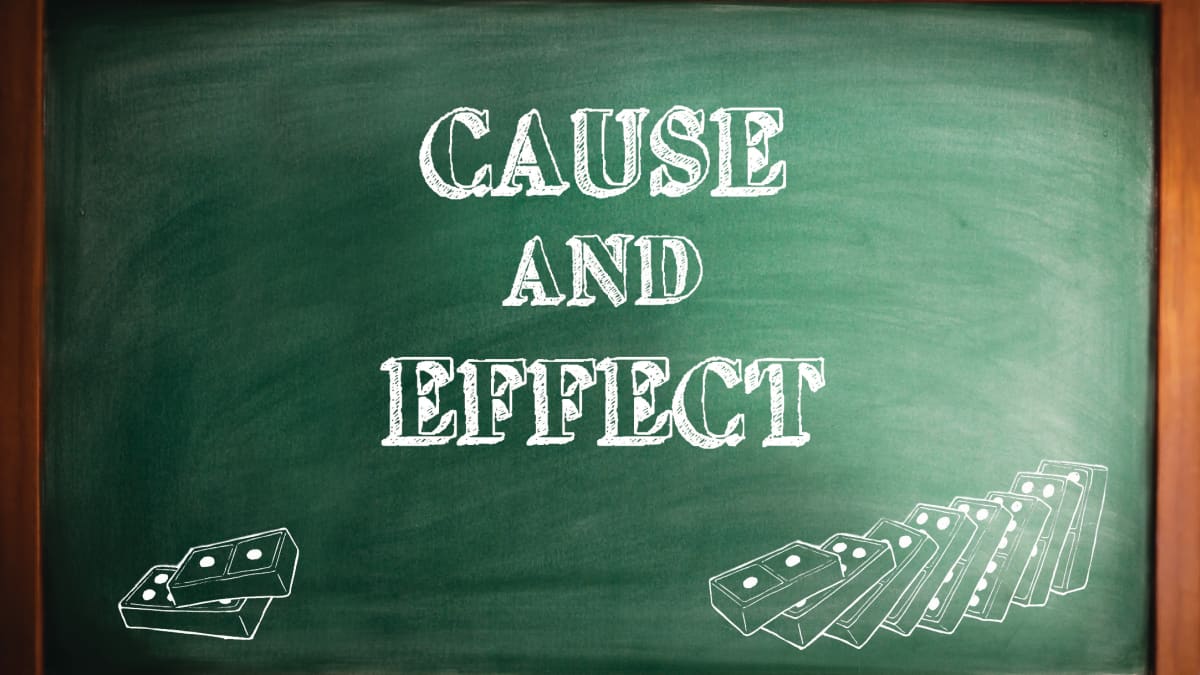
Cause and effect is the relationship between two things when one thing makes something else happen. For example, if we eat too much food and do not exercise, we gain weight. Eating food without exercising is the “cause;” weight gain is the “effect.” There may be multiple causes and multiple effects. Looking for the reason why things happen (cause/effect) is a basic human drive. So, understanding the cause/effect text structure is essential in learning the basic ways the world works. Writers use this text structure to show order, inform, speculate, and change behavior. This text structure uses the process of identifying potential causes of a problem or issue in an orderly way. It is often used to teach social studies and science concepts. The cause and effect text structure is generally used in expository and persuasive writing modes.
Sometimes writing prompts include signal words that show cause/effect relationships, such as: because, so, so that, if… then, consequently, thus, since, for, for this reason, as a result of, therefore, due to, this is how, nevertheless, and accordingly.
Cause and effect writing prompts will often ask the “why” question:
- Why are reality shows popular?
Sometimes they use words like analyze, connection, or relationship:
- What is the connection between greenhouse gases and climate change?
- Analyze the relationship between doing and learning
Other prompts may ask you to explain the cause and effect relationship. Look for the verb explain as a signal word so you answer the prompt correctly.
- Explain the effects of livestock production on climate change.
Depending on the assignment, you may be asked to look for different kinds of cause/effect relationships:
- Stated cause/effect relationships: the relationship is stated clearly
- Unstated cause/effect relationships: you will need to make inferences or “read between the linked” to make connections in the relationship
- Reciprocal cause/effect relationships: effects may be part of a chain. In this kind of structure, one effect goes on to cause a second effect, which may then cause a third effect, etc.
Approaching the Assignment
Step 1: Look for unstated cause-and-effect relationships
Step 2: Look for the signal words that show cause-and-effect relationships.
Step 3: Look for effects that are also causes. Effects can form a chain in which one effect goes on to cause a second effect, which may then cause a third effect and so on.
Formatting Cause and Effect
Cause/effect paragraphs generally follow a basic paragraph format. That is, they begin with a topic sentence and this sentence is followed by specific supporting details.
Synopsis:
There is a man that living a life. He has numerous problems continously in his life and this make him believe that the earth rotates. He feels like he is always been in the same position until he has a journey that changes his mind.
Exercise:
The dialog:


Video:
Comments
Post a Comment